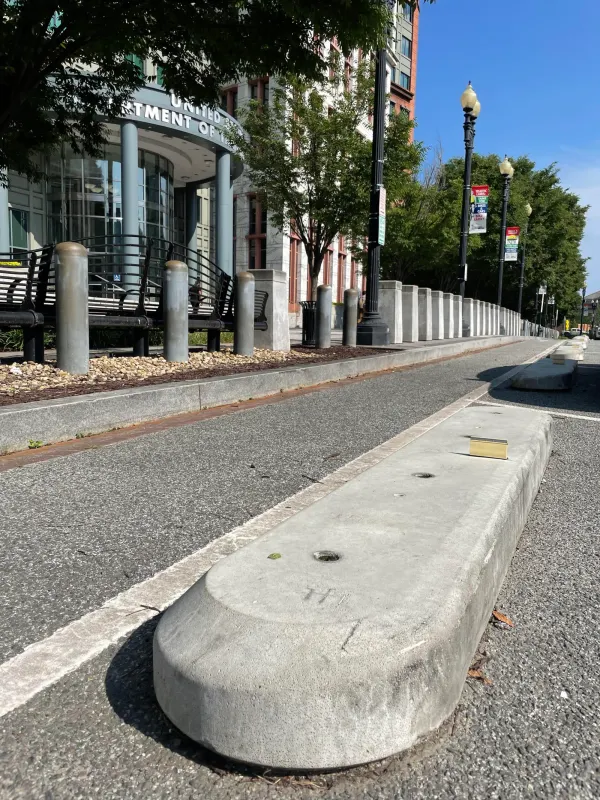
Want people on bikes to obey the rules? Then design for them.

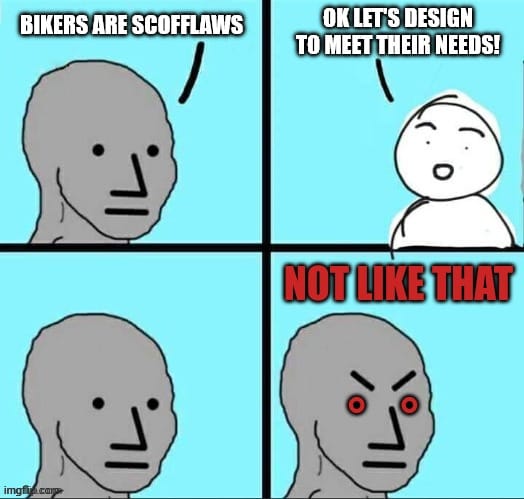
Your hyperlocal social-media feed is probably a firehose of misspelled all-caps comments about how bikers break all the rules. Good news, neighbors – something has been shown to improve compliance by people on bikes. And if we do more of it, we can keep on improving. It is the same thing that works on people who are driving – empathetic design. If we design for people on bikes, people on bikes will comply with the design. I've provided the meme below for your use in the replies after you suggest this on Nextdoor:
Human factors study absolutely fascinates me. There are some things – at an unconscious level – that most of our brains somehow share. It wasn't until I got into transportation that I realized how many of the little details of every street – sign designs, markings, geometry – are the direct result of careful study of how we react semi-consistently to both major and minor changes in the built environment.
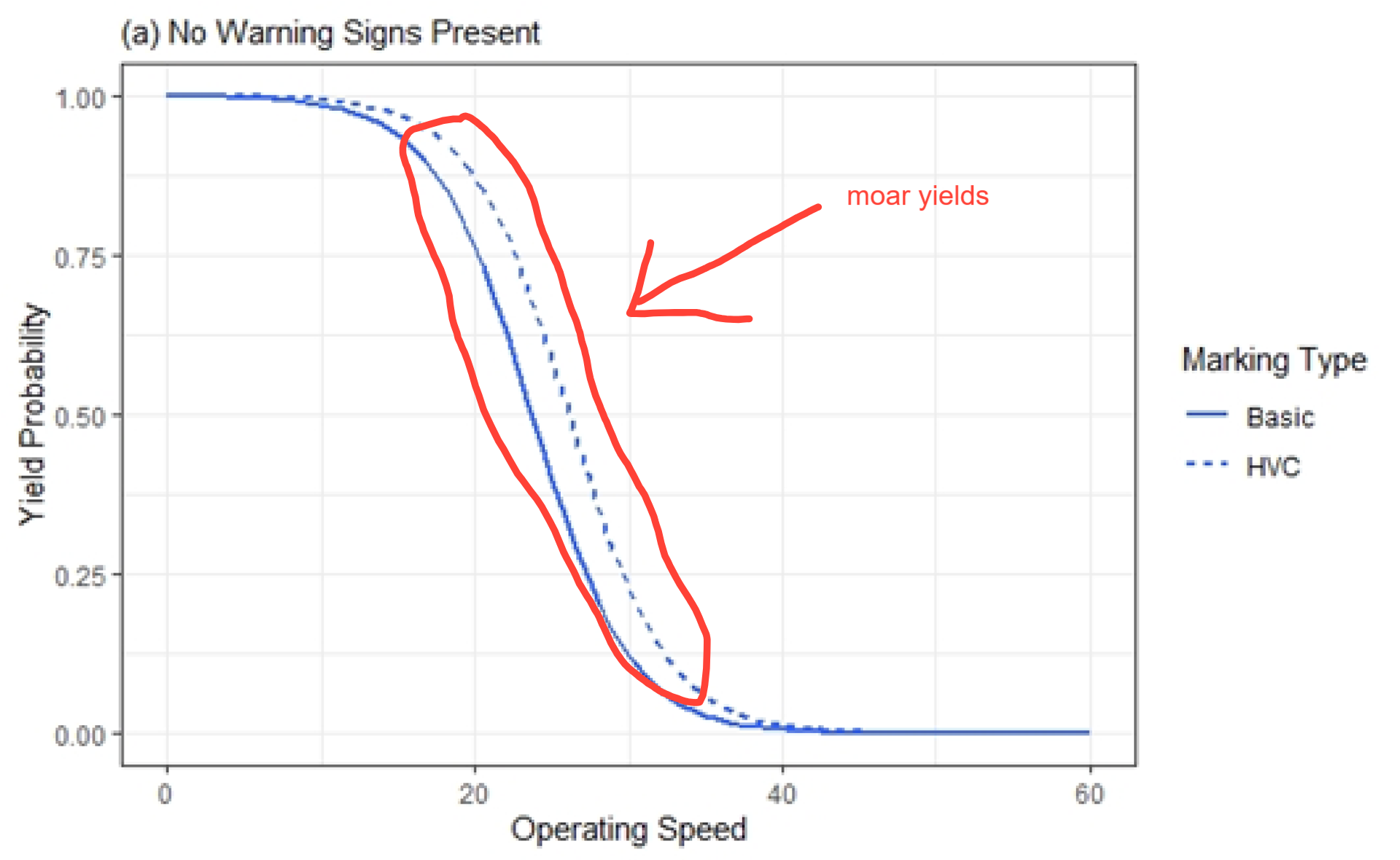
One such project that I managed with FHWA sought to answer what seems like an impossibly narrow question – all else held equal, are drivers more likely to yield to pedestrians at two-lane uncontrolled intersections if we use high-visibility crosswalk markings? To test this, researchers selected 32 intersections that met our criteria, and experiment participants stepped out from the curb when a car was approaching. Observers measured the speed of oncoming drivers, and logged whether or not they yielded.
The study team observed over 1,200 such interactions. And yes, high-visibility crosswalk markings made a small but significant difference in the propensity of drivers to yield.
Add some simple signs into the mix, and the compliance curve gets even better:
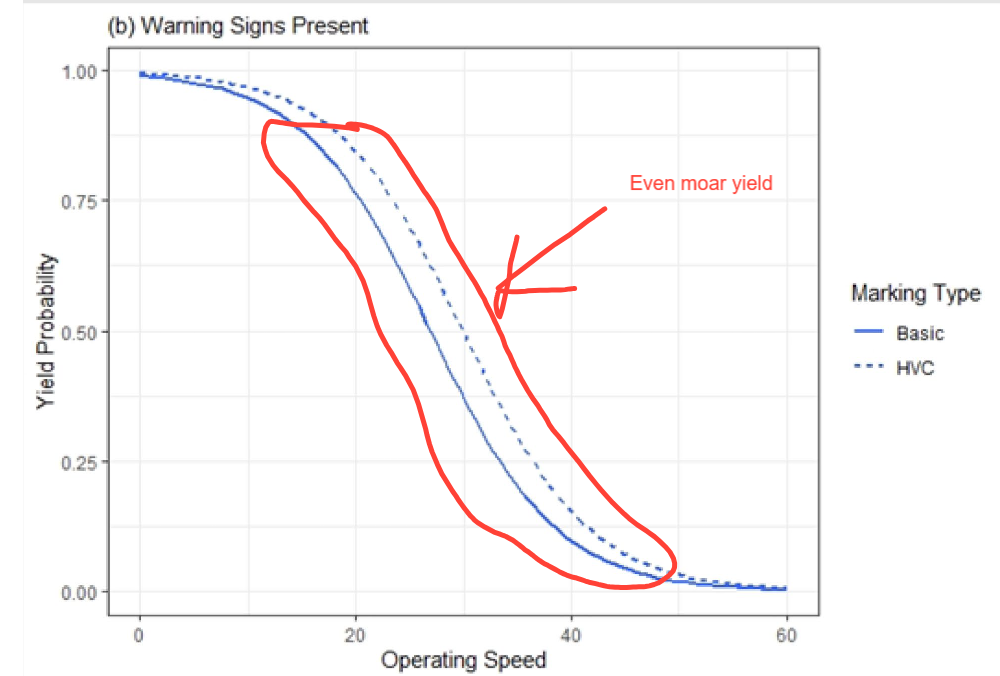
Maybe that is not a surprising result, and it certainly is not dramatic. But it hopefully contributes to the evidence that results in changes someday in crosswalk marking guidance for a city, a state, AASHTO, or the MUTCD. Staging and observing 1,200 interactions is a lot of work, and thus, a lot of money. But our national transportation research system conducts these sorts of experiments all the time. The MUTCD demands these sorts of experiments just to alter a sign or introduce a new pavement marking. And in theory, that's great. That's science, that's data-driven decision-making.
Two things stuck with me after this project:
- No one involved in the project, at any stage, expressed any blame or rendered any judgment about the many drivers who broke the law* and did not yield to a person clearly waiting to cross at a marked crosswalk. The only question was, "Would this design tweak get actual behavior closer to the design intent?" and the answer was "Yes."
- The transportation practitioner community has yet to fully extend that presumption of fallibility – that people walking or (especially) biking are not just innately scofflaws, but rather are people who can be nudged toward following design intent through better and more empathetic design.
The common denominator – we are all people. If we fully extended the presumption of fallibility to the people on bikes that we do to the people driving cars, we will further improve compliance. Repeating a point from earlier: If you design for the people on bikes, people on bikes are more likely to comply with your design.
Before we delve further, let's acknowledge but set aside four common responses to that charge – sometimes we break the traffic code because doing the noncompliant thing is sometimes safer, sometimes the thing decried as noncompliant is not actually against the law, drivers routinely break the law as well, and noncompliance by drivers puts others at far greater risk.
Bike-specific signals are one promising design feature that have been shown to increase compliance. One large-scale study observed 77-93% of people on bikes complying with bike-specific signals. These rates were nearly identical to those of people driving complying with their corresponding controlled-turn red arrows. Bike-specific signals also hold future promise in improving compliance, by providing yellow clearance times that are specific to bicycle speeds, and by providing leading intervals.
Another proven traffic signal measure that can increase compliance by people on bikes is shortening the cycle length, and thus reducing the wait for a green light. People walking and bicycling both are prone to violating a red signal when delay exceeds 30 seconds.
Moving away from the intersections, protected bike lanes demonstrate a number of positive impacts on user behavior. A primary benefit is that the comfort of protected bike lanes lures many users off of sidewalks. Another is accommodating a noncompliant behavior. My favorite project was 17th St NW. We observed that a ton of people were riding their bikes northbound on a southbound-only street. So we installed a contraflow bike lane. Compliance achieved.
However, there are so many other aspects of bicycling behavior where we need to experiment and learn how to improve compliance. A big one is bicyclists yielding to pedestrians crossing a bike lane, particularly in a constrained space like a floating or shared-platform bus stop. This is a particularly urgent issue, as pedestrian/bike crashes at these stops pose an acute risk to people alighting from a bus, particularly those with disabilities.
When confronting that exact question at FHWA, we searched for any US research done on signage, marking or geometric treatments that demonstrated significant changes in bicyclist yielding, and found none. I couldn't turn up anything new in a recent search of TRID. Calls to abandon the floating bus stop design are understandable. However, before we force kids and seniors on bikes to try navigating mixed-space interactions with buses, I believe we should be seeking effective ways to communicate and enforce bicyclists' responsibility to stop for people boarding and alighting those buses.
Traffic calming for people on bikes is another under-studied frontier. In Somerville, MA, the city recently addressed issues with speed on a newer mixed-use trail with "rumble stripes." I could not find any research assessing the efficacy of these, or the impacts on ride quality. I used them in a past project myself, for lack of any other proven alternatives. I wonder how effective they will be on users of the fastest vehicles on the trail, which often have wider shock-absorbing tires. I wish we had more proven solutions for managing speed of bicycles, e-bikes, e-motos, and all of the other devices that are sharing space.
The bottom line for your neighbors on Nextdoor is that if they want to see greater traffic code compliance from people on bikes, they should support designs that intentionally design for people on bikes.
My open tabs
The Centers for Disease Control (CDC) released a report on the negative correlation between physical activity and prevalence of frequent mental distress in their Morbidity and Mortality Weekly Report - https://www.cdc.gov/mmwr/volumes/75/wr/mm7539a1.htm
City Thread and the Urban Cycling Institute have collaborated on a new workbook and video on delivering on a vision for an active mobility culture in a community - https://www.citythread.org/blogs/a-new-workbook-for-cities-building-a-cycling-culture
The League of American Bicyclists (I'm a board member) also have a workbook on bicycling advocacy, supplementing their League Cycling Advocate program - https://bikeleague.org/from-bike-lanes-to-big-wins-how-a-new-advocacy-toolkit-is-empowering-local-changemakers/