Transportation is partisan now, it's time that we embraced it.

I am writing this after staying awake until 3:30am consuming an inhumane dose of electoral stimuli from my social media feeds and the Kornacki Cam. And as always, I have no editor. So... it might get a bit rambly.
I have been obsessing lately about a sentiment I heard routinely from senior leaders – both civilian and political – in my combined 12ish years working in USDOT's civil service. "Transportation is bipartisan." "There are no Democrat roads or Republican roads." "We are so lucky to work in an agency that is above the partisan political fray." Yeah, that's... um, yeah.
As a pseudo fifth-columnist for those of us who think the country would be a better place if more people could drive less than they do now, every reminder of that bipartisanship was, frankly, a morale killer. Working within the terrible status quo of our system - an inequitably-killing, environment-wrecking, health-harming drag on everyone's time and prosperity... and knowing that the mainstream of both parties say, "welp," I would have loved to see a bit more of what we call "partisanship" in a political context, but we could also call "fighting for what's right" in talking to actual people.
But without a clear mandate to change much, our primary agency mission at FHWA was instead to act as stewards for the Federal investment in mostly State-led projects and plans. The legislative formulas aim a largely-fixed firehose of cash at the States, and it is spent with little codified regard for outcomes. Social Security for highway spending, basically.
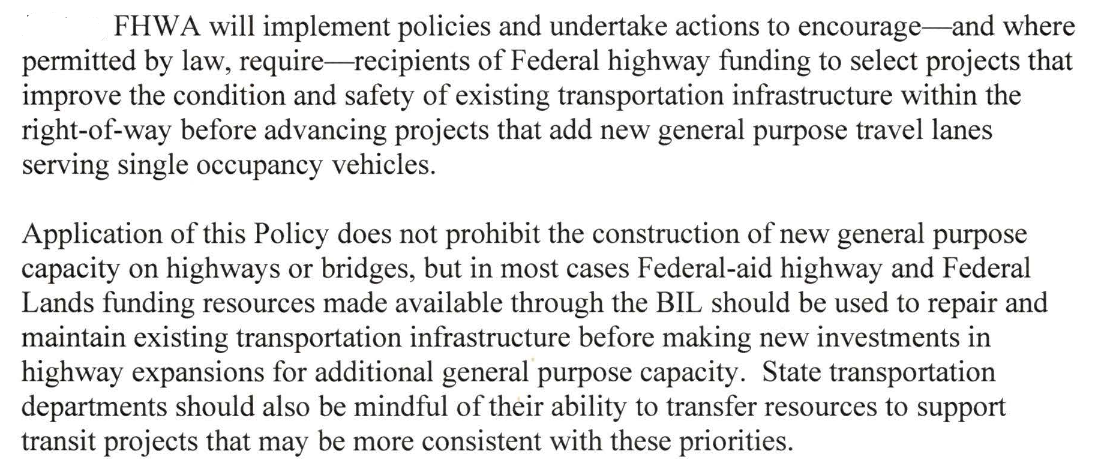
The Biden era leadership and Congress did try to make some structural changes via IIJA and IRA, primarily by adding a huge roster of discretionary grant programs. But the only real attempt to sharpen the aim of the formula firehose was a memo from late 2021, titled "Bipartisan Infrastructure Law Resources to Build a Better America," soon after IIJA passed.
Addressed to the heads of FHWA Division Offices by then-Deputy Administrator Stephanie Pollack, it was technically internal guidance that was intended to be shared with State DOTs as a statement of principals that FHWA would follow in carrying out IIJA. The main theme was that, to the extent allowed by law, FHWA would be encouraging States to prioritize investment in state of good repair, measures that mitigated any need for new capacity, and to consider equity, climate resilience, and investments off the State system. It promised follow-on guidance and regulations to implement this new focus.
THIS was an agency where I wanted to work:
I do not know what exactly happened next. I do know that the American Association of State Highway Transportation Officials (AASHTO) responded on behalf of its membership, diplomatically laying out its case that they were already pursuing the goals described to the extent practicable, and that they were best positioned to deliver IIJA programs.
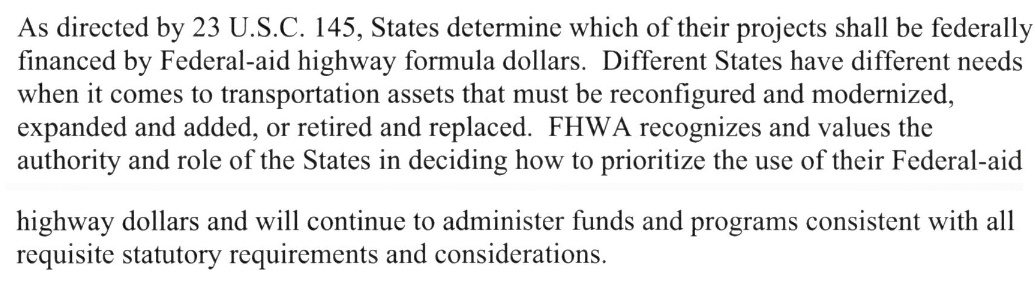
Jump forward to early 2023 – Deputy Administrator Pollack was reassigned elsewhere, and a new Senate-confirmed Administrator issued a new, replacement memorandum. It struck a rather different tone:
The Trump Administration then came into power, with some very different ideas about implementing IIJA. The transportation section of Project 2025 sought to "refocus the FHWA on maintaining and improving the highway system," and railed against how, "the Administration has sought to use a 'guidance memo' to impose policies not enacted by Congress, most notably to make it harder for growing states to expand highway capacity."
Executive orders replaced 'guidance memos,' DOGE nudged 28% of FHWA's employees out the door, critical data-driven resources were taken down from the web, "DEI Bike Lanes," and scores and scores of grants were held up. All of this was done without the consent of Congress (or any trace of awareness of the irony).
Even before the Trump Administration blew up the Executive Branch, it did not appear that IIJA would accomplish a change commensurate to our investment to our built-environment, equity, existing patterns of funding distribution, or hopes of reducing transportation greenhouse gas emissions. Leaving decisions on how to spend the largest and most predictable program funds solely to State DOTs played a role in that. With an administration that hates and actively works against many of IIJA's stated goals, this will only worsen in IIJA's waning months.
It is time to give up on the failed strategy of trying to optimize the administration of a flawed twelve-figure program. It is time to cash in some of that political mandate, and deliver a better program. And "better" =/= "bipartisan."
Earlier this year, the House of Representatives' Transportation & Infrastructure (T&I) committee drafted and passed (62-2) a new bipartisan transportation authorization bill, the BUILD America 250 Act. It was immediately panned for how it "reduces the country’s capacity to protect against rising environmental damage," "does not adequately address the significant infrastructure funding gaps for cities and transit agencies," and is, "a fairly status quo proposal that fails to meet the moment and will not deliver a transportation system that safely, affordably, and reliably gets us all where we need to go." Ouch.
But that's history. House Democratic leaders can and should direct their incoming T&I Committee leaders to hit the reset button. Chairman Sam Graves (R-MO) is retiring, Rep. Scott Perry (R-PA, a consistent opponent of bike lanes, streetcars, and AMTRAK) was defeated, and (as of this writing) 21 other of their current T&I colleagues are leaving Congress because of retirement, higher office, or electoral defeat:
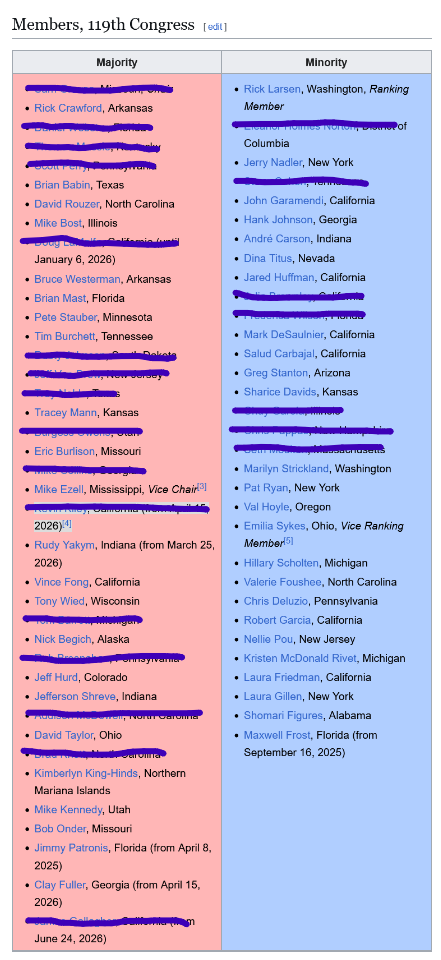
Advancing another woefully inadequate transportation bill reflecting deep compromises made to placate 23 former members should not be a priority of the 120th Congress. Last night provided a dramatic mandate for change, and we should pursue a new transportation program that seeks to achieve things that deliver a better system (or putters off into the sunset).
A radically new Congress, with a new committee, warrants a clean sheet of paper that is consistent with the mandate provided by the largest popular-vote win margin since the Watergate era. Voters rejected Scott Perry's priorities. Democratic Senators currently serving in the minority on the Environment and Public Works Committee helpfully provided their own excellent statement of principles for the next transportation authorization. Start there.
The new Democratic Congress will have many things on its plate. Providing accountability to the Executive Branch will consume a lot of bandwidth. However, NYC Mayor Zohran Mamdani is showing the power of demonstrating to your constituents how "the nuts and bolts of governing are part of a bigger social vision." The transportation authorization is a big piece of hardware that the 120th Congress can deliver, and help to bring the American voter around to their vision. It won't be easy to balance that work with the job of serving as a backstop for our democracy. But as Sen. Raphael Warnock stated, "we can walk and chew gum at the same time."