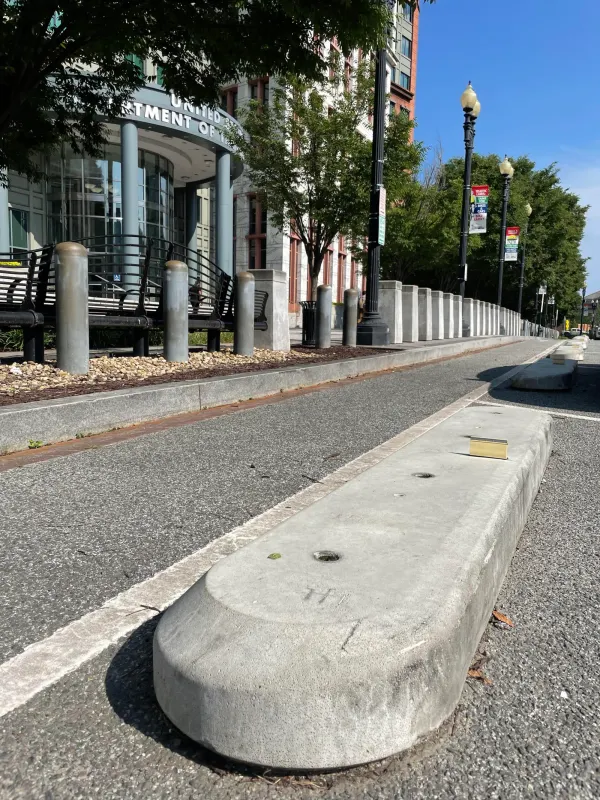
Should those cute little mini cars travel in bike lanes or trails?


Sorry... no.
This week brought the happy news that Toyota would be selling (primarily for fleet users) the kei truck shown above in the US. This little chonk follows Stellantis offering the Fiat Topolino here, and together, these two will be an adorable opening salvo of what is hopefully a bunch of new, safer, cleaner ways (relative to traditional passenger cars and trucks) to get around under the Low-Speed Vehicle (LSV) category.
Per the Federal Motor Vehicle Safety Standards, LSVs (also referred to as Neighborhood Electric Vehicles (NEVs) and Light Urban Vehicles (LUVs)) are intended to fill a niche for shorter door-to-door trips only traveling on streets with a speed limit 35mph or below, using small vehicles that cannot exceed 25mph, do not weigh more than 3,000 lbs, and include some car-like features such as seatbelts and windshields. In a city like mine, where no streets have a posted speed above 35mph, LSVs have a ton of potential. One local small business uses an older imported kei truck to get around, and I appreciate having one less Ford F-150 looming over our streets.
But there's a couple of reasons why LSVs have not taken off the USA. First, people are rightly hesitant about driving small, relatively-slow and -lightweight vehicles in mixed traffic. Second, we have bisected many of our communities with higher-speed arterial highways, and placed many of our necessary destinations directly on those routes, thus degrading the utility of a vehicle that cann0t travel those corridors. To a bicycling guy, this all sounds very familiar. Until recently, the overwhelming response to this has sadly been, "ban them" (also familiar).
Famously, The Villages built an entire active senior planned community with a network of paths for bicycling and LSV use. A smattering of other suburban communities (such as Peachtree City, GA) have allowed golf carts on their multi-use trails, prompting idle talk of more widespread allowance allowing LSVs on bike facilities and trails. No state currently allows this, and those communities that allow LSVs or golf carts on their paths are private planned developments.
The potential for LSVs to replace short car trips with less energy expenditure led the US government's Joint Office of Energy and Transportation (RIP) to put some oomph behind LSVs. One of those efforts was a $750,000 grant to CityFi and the Shared Use Mobility Center (SUMC) to create a framework and model statutes for LSVs, to include answering the question of, "Where can they be ridden/driven?" This work was going to include consideration of how the range of commercial freight e-cargobikes (that can currently use bike-specific facilities under local statutes) related to the larger LSV ecosystem.
I reached out to representatives of both CityFi and SUMC to ask if work on their framework had proceeded, if they had considered the issue of where LSVs could or should travel, and if bicycle facilities had been considered, but did not receive any response. I will update this post on the web if I do.
LSVs are clearly having an overdue moment, and our communities would be improved by their increased uptake. Knowing what the introduction of e-motos cosplaying as bikes has done to the safety and appeal of bike facilities, I appreciate the need for a consistent and safety-focused regulatory framework. Now is the time to have this discussion about LSVs, because I for one would love to see my aging mom tootling about in a Fiat Topolino.
I also believe that there is a theoretical formula for what type of vehicles should be allowed on bike lanes and trails, in order to protect the safety and comfort of those of us using them now. That formula not only considers speed, power, method of assist, and power source, but also width, weight, noise, and (to borrow a term from architecture) massing. I do not know where the exact tipping point is, where a vehicle should be restricted to shared-use lanes (or perhaps allowed into bus lanes?). But based on all of the criteria above, e-motos and LSVs both fall beyond it.
The REAL solution to lowering the network barriers to LSV use is the same as it has always been for creating livable communities: Reduce the design speed of the majority of streets on a network – including arterials with destinations along them – to the more humane and non-lethal speed of 20-25mph. Welcome to the War on Cars, LSV advocates.